Phase 2: The Certified Blueprint Architecture
The Core of ERP Success: Defining Requirements
After mapping out your current business processes, the next critical step is to define what you need a new system to do. This is known as Business Requirements Gathering. It is a structured process of identifying, documenting, and managing all the functional and non-functional needs that the new ERP system must fulfil.
In simple terms, it's about translating a company's day-to-day activities and future goals into a comprehensive set of requirements. This includes everything from how many users need to access the system to specific reports you need to run, and even performance expectations. Without a clear set of requirements, it is impossible to accurately evaluate and choose the right ERP system.
Structured Workshops & Stakeholder Alignment

Structured Workshops
We facilitate workshops with your key stakeholders from across the business—from finance and sales to operations and leadership. Our role is to ask the right questions and ensure every voice is heard, documenting both the obvious and the hidden requirements.

Creating the Business Requirements Document (BRD)
We take all of the information gathered during these sessions and transform it into a clear, concise, and comprehensive BRD. This document serves as your single source of truth and the blueprint for the entire project. It's a powerful tool that gives you control during the vendor evaluation process.

Your Technical Translator
We act as your technical translator. We ensure that your business needs are articulated in a way that ERP vendors can easily understand and respond to. This minimizes miscommunication and ensures that vendors are proposing solutions that truly align with what you need, rather than what they think you need.
The Requirements Taxonomy: Scoring and Prioritisation
Our workshops go beyond simple brainstorming. We facilitate a structured requirements taxonomy process to remove ambiguity. During this phase, we work with your stakeholders to categorize every single requirement into clear priority tiers:
Must-Have (M): Non-negotiable features critical for immediate business operations.
Should-Have (S): Important features that offer significant business value but are not required for launch.
Could-Have (C): Desirable features that can be considered in later project phases (Phase 2 or 3).
Exclusions (E): Clear documentation of functionality that your team currently uses but will be explicitly removed or replaced in the new system.
This scoring ensures that your Request for Proposal (RFP) responses are focused only on features that truly matter, saving your team time and simplifying vendor comparison.
BRD as the Control Document
Powering Internal Control: Your Vendor-Neutral Baseline
The Business Requirements Document (BRD) is your definitive internal master plan. It establishes a necessary baseline for control, risk mitigation, and cost management that you own before any external vendors are engaged.
Risk-Free Customisation Control: The detailed planning in the BRD minimises last-minute customisation requests—the number one driver of budget overruns and long-term maintenance inflation—allowing you to directly control your Total Cost of Ownership (TCO).
Legal & Technical Baseline: The BRD becomes your Statement of Work (SOW) baseline. We structure the document so that its precision can be legally integrated into your final contract with the chosen vendor, establishing the official standard for delivery.
100% Accuracy for RFP Creation: We leverage the validated requirements, processes, and data flows from the BRD to write the official RFP document. This rigorous approach ensures the RFP is accurately scoped, professional, and unassailable.
The Final Deliverable: Your Business Requirements Document (BRD)
At 4bluefeet, we simplify the requirements gathering process, ensuring nothing is missed. We go beyond simple checklists to capture the true essence of your business's needs.
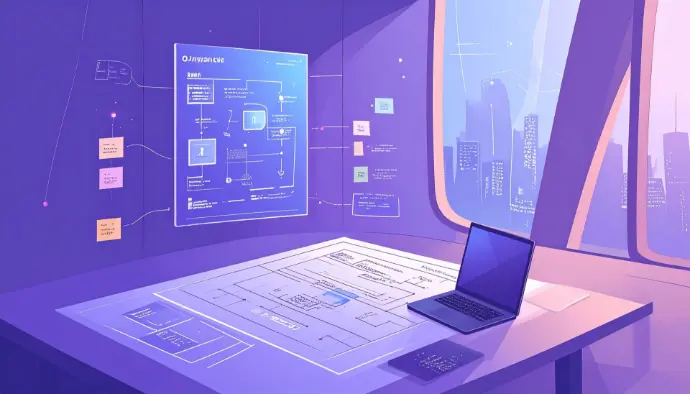
Our Business Requirements Document (BRD), or equivalent detailed design documentation, serves as the cornerstone for every successful ERP implementation. This critical blueprint meticulously outlines your proposed solution, ensuring a robust and tailored system architecture.

Detailed Solution Blueprints
This is the core deliverable, meticulously documenting the end-to-end functionality of the future ERP environment. It links every item in the Requirements Catalogue (from Phase 1) to a specific, designed technical or process solution. This design document covers:
Process Mapping Refinement: Detailed, level 3 and 4 process flows, specifying activity steps and user roles for the TO-BE state.
Module and Scope Definition: Defining the exact boundaries of the necessary ERP modules and supporting systems.
High-Level Data Model: Specifying the critical master data structures and transaction data flows required to support the new processes.

Integration Landscape Architecture
We define the complete ecosystem and the required integration points between the new ERP and all existing or necessary third-party applications (e.g., PLM, WMS, e-commerce). This deliverable includes:
A visual Integration Map showing data exchange protocols, frequency, and critical data elements for each connection point.
A preliminary Customisation Register, flagging areas where standard functionality will not suffice, allowing for pre-tender risk assessment.
Data Migration Strategy Outline

Customisation & Development Specifications
Detailed outlines for any required custom developments or enhancements to tailor the ERP to your unique business processes.

Robust Reporting Requirements
Definitions for all essential reports and analytics, empowering data-driven decision-making.

Thorough Testing & Training Plans
Strategies for rigorous system testing and comprehensive user training to ensure smooth adoption and operational readiness.
The Value of a Certified Blueprint
Developing this detailed design independently of the final vendor is a non-negotiable step in mitigating risk:
Vendor Neutrality: We maintain technical fidelity by designing the solution based on best practice, free from the biases or limitations of a single software platform.
Accelerated Implementation: The selected vendor inherits a pre-approved, detailed design, significantly reducing their discovery phase and accelerating the start of implementation.
Guaranteed Fit: By detailing the 'how' before the RFP, we ensure that only vendors who can certify against the Blueprint progress to the final selection stage.
Next Step in the 4bluefeet Methodology
With the Certified Blueprint Architecture approved, the project is ready to move into: Phase 3: Objective Vendor Selection & Investment Modelling – Using this Blueprint as the non-negotiable input for the Request for Proposal (RFP) to engage the market and select the ideal vendor partner.
Foundational Strategy & Baseline Architecture
Key Deliverable: The AS-IS/TO-BE Process Architecture and the Final Requirements Catalogue.
The Certified Blueprint Architecture
Key Deliverable: The 4bluefeet Blueprint Document (BRD), certified for technical feasibility.
Objective Vendor Selection & Investment Modelling
Key Deliverable: Validated Vendor Suitability Report and the Financial Investment Model.
Organisational Readiness & Adoption Framework
Key Deliverable: Change Impact Assessment (CIA) and the Organisational Readiness Framework.
Integrated Quality Assurance Oversight
Key Deliverable: iQA Sign-Off and the UAT Completion Certificate.
Cutover Assurance & Performance Governance
Key Deliverable: Cutover Readiness Audit and the Long-Term Governance Model.
The BRD Blueprint: Requirements, Risk & Vendor Control FAQs
Get answers on how the Business Requirements Document (BRD) serves as your single source of truth, ensuring vendors propose tailored solutions and keeping your ERP project on budget.
- BRD (Business Requirements Document): This is an internal planning tool created by you and 4bluefeet. It defines what your new ERP system must do, outlining the functional and non-functional requirements, 'To-Be' processes, and technical specifications. It is vendor-neutral.
- RFP (Request for Proposal): This is a vendor solicitation tool. It sends the finalized BRD out to potential ERP vendors and asks them how they will meet your requirements, including their pricing, implementation plan, and technology stack.
The BRD is the necessary input required to write an effective RFP.
Process mapping (BPA) shows the current and future state of your business operations. However, a BRD translates those processes into technical action. The BRD contains several elements the maps do not:
Requirements Taxonomy: Prioritisation (Must-Have, Should-Have).
System of Record: Defining which system owns which data.
Technical Specifications: Detailed blueprints for integrations and necessary custom development.
Formal Acceptance: A finalised, binding document that forms the legal basis for your contracts with the eventual vendor.
A BRD turns a wish list into a contractually enforceable blueprint.
The timeline is highly dependent on the scope and complexity of your organisation. Factors include the number of critical departments (e.g., Finance, Warehouse, Manufacturing), the complexity of your data flows, and the availability of your key stakeholders.
For a typical mid-sized business (50–500 employees), the process usually takes 4 to 8 weeks from kickoff to final document sign-off. We provide a detailed project plan after our initial discovery call.
While no ERP project is entirely without challenges, the primary goal of the BRD is risk mitigation. We guarantee that our vendor-neutral BRD will eliminate ambiguity and define a fixed scope upfront. This prevents the primary causes of project failure, such as scope creep, vendor misinterpretation, and hidden customization costs, putting you in the strongest position possible for success.
Absolutely. The BRD is your most powerful negotiation tool. Because the document clearly details all functional requirements and necessary custom work, vendors cannot inflate prices with unnecessary features or ambiguous scoping. It forces them to provide precise, "fixed-scope" pricing based on your exact needs, giving you a competitive edge.
Ready to Define Your Requirements? Contact 4bluefeet
Stop worrying about project failure and budget overruns. We guarantee that your custom Business Requirements Document (BRD) will be the most effective, vendor-neutral tool you need to proceed with confidence.